Without gravity, the spine expands and height increases by about 2–3 cm; after returning to Earth, it returns to normal.
The Moon is slowly moving away from the Earth.
Each year, the Moon moves about 3.8 cm farther away from our planet (roughly the amount a human fingernail grows in a year).
When we look at the stars, we are looking into the past.
Light takes thousands or even millions of years to reach us, so we see what they were like, not what they are now.
It may rain diamonds on Neptune.
Gas giants have such immense pressure that carbon can turn into solid crystals.
Stars “sing.”
Their vibrations can be converted into sound waves — a field known as asteroseismology.
Space has its own smell.
Astronauts say that after spacewalks, their spacesuits smell like seared steak or welding fumes.
Sunsets on Mars are blue.
Unlike on Earth, where the sky turns red during sunset, sunsets on Mars appear bluish due to the specific dust in its atmosphere.
Saturn’s rings are temporary.
Although they appear eternal to us, Saturn is slowly “eating” its rings. Due to gravity and magnetic fields, the icy particles of the rings fall into the planet like rain.
Water reserves are floating in space.
Astronomers have discovered a massive cloud of water vapor around a quasar, containing 140 trillion times more water than all the oceans on Earth.
A day on Venus is longer than a year.
Venus rotates so slowly on its axis that one of its days lasts longer than a full orbit around the Sun.
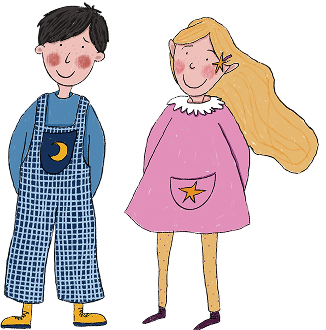
Aurora and Vesper
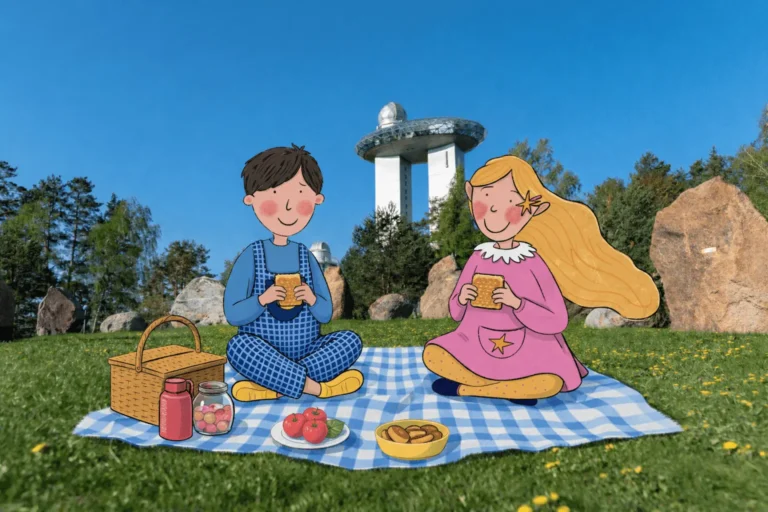
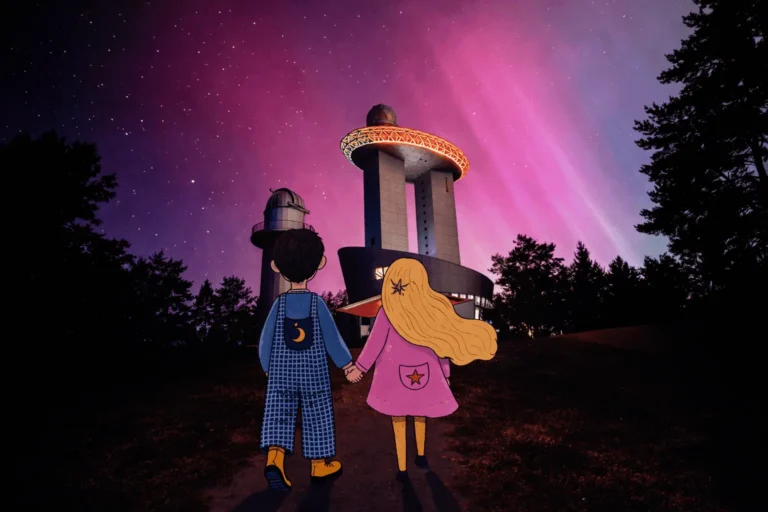
Aurora and Vesper are brave, adventure-seeking characters driven by curiosity and a desire to understand the world. They have joined the museum team to help you discover Lithuanian traditions of sky observation and the latest achievements of modern science.
Aurora is the Morning Star. She was born from the first ray of dawn. She awakens people to a new day, bringing curiosity, hope, and a longing for knowledge.
Vesper is the Evening Star. He was born from the Sun’s final breath, when blue and violet shadows fill the sky. Vesper protects people from the fear of darkness and invites them to reflect on the mysteries of the Universe.
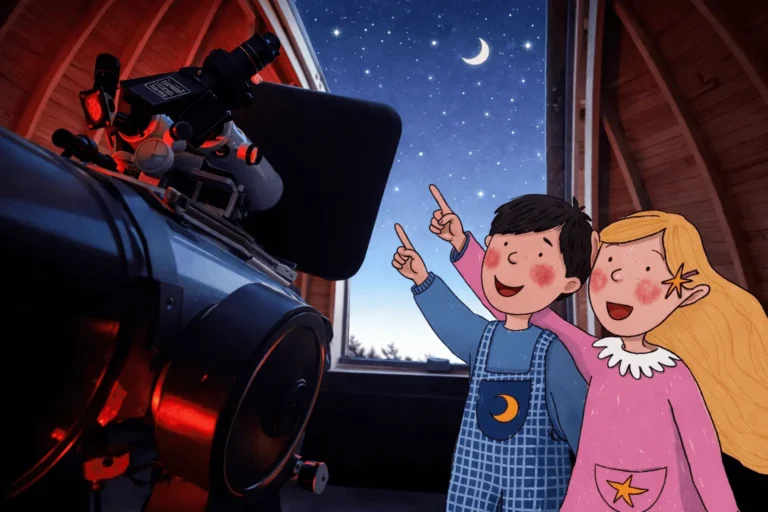
When the sky begins to darken, the little explorer raises his eyes upward. There, stars twinkle, the Moon shines, and mysterious celestial bodies hide. He is very curious—what are they and why do they shine?
The little explorer knows: to discover, one must observe. He learns to wait patiently, to search for the brightest lights and to recognize which of them are stars and which are planets. Sometimes he finds the Evening Star in the evening sky, and sometimes the Morning Star in the early morning.
Each discovery begins a new question. Why does the Moon change its shape? Where do the stars disappear during the day? Do other children, looking at the sky, feel the same way?
The little explorer understands that the cosmos is a great book of mysteries. And everyone who looks at the sky with curiosity is already a true explorer.
I am curious.I promise to look up at the sky more often and watch how the stars shine.I promise to ask questions when I do not understand something and to celebrate every discovery.
I will explore the sky, the planets, and the Moon.I will learn to observe patiently, to wait, and to notice even the smallest lights.
I will respect nature, the Universe, and the mysteries that are still waiting for answers.
I promise to protect my curiosity, because it helps me grow, learn, and dream.
And when I grow up, I will always remember: every great discovery begins with a small question.
Did you know that Vakarinė and Aušrinė are the same planet?
Long, long ago, people noticed two bright “stars” in the sky. One appeared in the evening, when the Sun was setting – it was called Vakarinė (the Evening Star). Another shone early in the morning, before sunrise – this was Aušrinė (the Morning Star).
Only later did people realize that these were not two different stars, but the same planet – Venus. It orbits the Sun in such a way that sometimes we see it in the evening and sometimes in the morning. Venus is very bright, so it is easy to notice even with the naked eye.
Our ancestors considered Vakarinė and Aušrinė special. They created stories and songs about them and believed they protected the sky. Look at the evening or morning sky and try to find it yourself. Perhaps you will see the same light that people were watching hundreds of years ago!
This website uses cookies. In order to ensure the best browsing experience for you, we use cookies on this website. To agree, click the „Allow All“ button or you can change your settings by clicking the „Change Preferences“ button.
Change preferences
Only necessary
Confirm selection
Allow all
This site is registered on wpml.org as a development site. Switch to a production site key to remove this banner.